Point-to-point integration is a method of connecting two systems directly, so they can exchange data, files, or transactions without relying on a centralized integration hub. In its simplest form, point-to-point integration creates a dedicated connection between two applications, databases, platforms, or endpoints for a specific purpose. For example, a company may connect its Customer Relationship Management (CRM) platform directly to its billing software, so customer records can automatically transfer between systems.
Each point-to-point integration is typically built around a single workflow or data exchange requirement.
One connection may transfer inventory updates, another may synchronize customer records, and another
may move financial files between systems. These integrations are commonly created using Application Programming Interfaces (APIs), custom scripts, database queries, secure file transfers, webhooks, or lightweight middleware tools. Since the connection is purpose-built, organizations can customize the logic, formatting, authentication, and routing specifically for the business process involved.
Point-to-point integration differs from centralized integration platforms and architectures as there is no single platform managing all data movement. In a centralized model, data flows through a hub such as an Enterprise Service Bus (ESB), Integration Platform as a Service (iPaaS), or Managed File Transfer (MFT) solution.
By contrast, point-to-point integration creates individual links between systems independently. Organizations often use this approach when they need a quick connection between two systems, when only a small number of applications are involved, or when the workflows are highly specific and unlikely to expand significantly over time.
How Does Point-to-Point Integration Work?
Point-to-point integration works by establishing a direct pathway between two systems that need to exchange information. In a typical workflow, one system generates or sends data; a direct connection transfers that information, and the receiving system processes, stores, or responds to the data. The integration may run continuously in real time, on a schedule, or based on event-driven triggers depending on business requirements.
Organizations can create these connections using a variety of technologies. APIs are commonly used for application-to-application communication, particularly in cloud environments. File-based integrations often rely on protocols such as FTP, FTPS, SFTP, and AS2 to exchange data between systems, applications, or trading partners. Other methods include database queries, custom scripts, webhooks, shared folders, and automated file transfers. Some organizations also use lightweight middleware tools to simplify connectivity while preserving a direct point-to-point relationship between systems.
The logic behind each integration solution is often custom-built for the specific workflow involved.
A connection may include data transformation rules, authentication requirements, routing instructions,
error handling procedures, and notification workflows.
For example, one system may export customer records in CSV format, while the receiving system requires XML or JSON formatting. In a small environment with only a few integrations, this model can remain relatively simple. However, as organizations add more systems, applications, partners, and workflows, the number of individual connections can grow rapidly and become difficult to manage.
Point-to-Point Integration Examples
Point-to-point (P2P) integration is widely used across industries as it provides a straightforward way to connect systems for targeted operational needs. One common example of P2P integration is connecting an Enterprise Resource Planning (ERP) system directly to a Warehouse Management System (WMS). In this scenario, inventory levels, shipping updates, and order information can move automatically between platforms without requiring manual data entry. Another example involves sending customer data from a CRM platform to a billing or invoicing system to streamline account creation and payment processing.
Retail and supply chain operations also rely heavily on point-to-point integrations. A retailer may transfer order files directly to a supplier using secure file transfer protocols, such as SFTP or AS2. Likewise, manufacturers may exchange purchase orders, invoices, and shipment notifications directly with trading partners through automated file-based workflows. Financial organizations often use direct integrations to move reports from internal databases to accounting firms, regulators, or external analytics platforms.
Healthcare organizations provide another common use case. Hospitals, clinics, insurance providers, and laboratories frequently exchange patient records, claims files, eligibility information, and billing data between systems. These transfers often require secure protocols and encryption because the information is highly sensitive and regulated. Beyond healthcare, businesses across nearly every industry use point-to-point integrations to connect multiple applications, cloud platforms, partner systems, and enterprise databases for secure data exchange and operational automation.
Benefits of Point-to-Point Integration
One of the biggest advantages of point-to-point integration is its simplicity. When only two systems need to communicate, organizations can often build a direct connection quickly without deploying a larger integration platform. This makes point-to-point integration especially attractive for one-off projects, urgent operational requirements, or narrowly scoped workflows where speed of implementation matters more than long-term scalability.
Another benefit is lower initial complexity. Small businesses or departments with limited integration needs may not require a full enterprise data integration architecture. Instead, they can create a focused connection that solves a specific business challenge with minimal infrastructure investment. As the integration is purpose-built, teams can customize workflows, data mappings, and automation rules specifically for the systems involved.
Point-to-point integration can also work well in environments with relatively few applications or partners.
If a business only needs to exchange data between two or three systems, managing individual connections may remain practical and cost-effective. Direct integrations can also help organizations address immediate operational issues quickly, such as automating file transfers, synchronizing customer records, or exchanging reports with external partners. Point-to-point integration also offers fast implementation and can solve immediate operational needs.
Why Point-to-Point Integration Becomes Difficult at Enterprise Scale
Although point-to-point integration works well in smaller environments, it often becomes difficult to manage as organizations grow. The biggest challenge is the development of what many IT teams call spaghetti architecture. As more applications, databases, cloud services, and trading partners are added, the number of direct connections increases rapidly. Each new system may require multiple integrations, creating a tangled web of dependencies that becomes increasingly difficult to monitor and maintain.
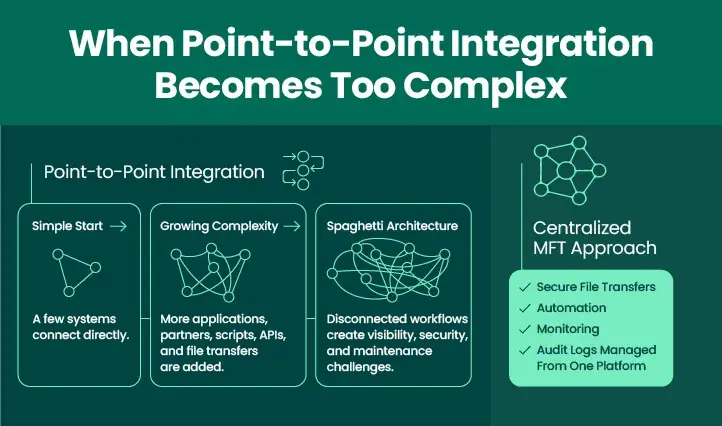
Enterprise environments are especially vulnerable to this problem as they often include multiple systems, such as a mix of cloud applications, legacy systems, partner networks, enterprise databases, and distributed teams. Compliance requirements add another layer of complexity, particularly when organizations must track sensitive data movement, maintain audit logs, and enforce security controls across every connection. What may begin as a handful of manageable integrations can eventually grow into dozens or hundreds of custom scripts, API integrations, file transfer workflows, and scheduled jobs operating independently.
This complexity creates real business risks. Troubleshooting failed transfers becomes slower because IT teams must investigate individual connections separately. Manual oversight increases as administrators monitor disconnected workflows and maintain custom scripts. Security gaps can emerge when older integrations lack modern encryption, authentication, or access controls. As a result, organizations may experience higher operational costs, reduced agility, increased downtime, and greater risk of data transfer failures that impact customers, partners, or internal operations.
How Managed File Transfer Supports Secure Integration
MFT solutions help organizations centralize and automate file-based integrations that might otherwise rely on scattered point-to-point scripts and manual processes. Instead of maintaining dozens of disconnected file transfer workflows independently, businesses can use an MFT platform to manage secure data movement from a centralized environment. This approach provides seamless integration, improves visibility, governance, and operational consistency across system integrations.
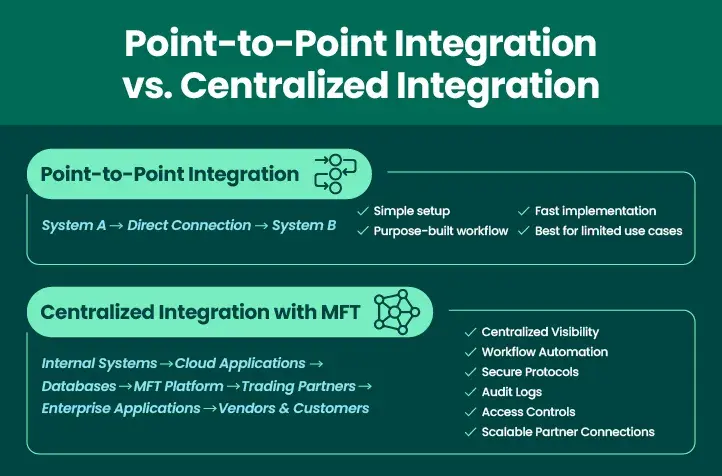
GoAnywhere MFT is one example of a MFT integration solution designed to support secure and automated integrations across enterprise environments. GoAnywhere supports secure file transfer protocols including SFTP, FTPS, HTTPS, and AS2, helping organizations exchange files safely with internal systems, cloud platforms, vendors, customers, and trading partners. The platform also includes workflow automation, scheduling capabilities, event-based triggers, centralized logging, encryption, and granular access controls to simplify secure data movement operations.
MFT solutions are especially useful for organizations that exchange sensitive or regulated information. Businesses in healthcare, finance, manufacturing, retail, and government sectors often need secure methods for transferring files while maintaining audit trails and compliance reporting.
GoAnywhere MFT also integrates with APIs, databases, cloud storage providers, and enterprise applications, helping organizations streamline workflows while reducing reliance on fragile point-to-point scripts. While MFT is not a replacement for every integration architecture, it can solve many secure file-based integration challenges more efficiently and securely than disconnected direct integrations.
When Should You Use Point-to-Point Integration?
Point-to-point integration can still be an effective solution when the scope of the integration remains limited and well-defined. If only two systems need to exchange data, a direct connection may provide the fastest and simplest path to automation. Organizations often use point-to-point integrations when the workflow is stable, unlikely to change frequently, and manageable from both a technical and operational perspective.
This approach also makes sense when data volumes are relatively low, and security requirements are straightforward. For example, a business may need to automate a nightly report transfer between two internal systems or synchronize customer records between a CRM and accounting application. In these situations, building a lightweight direct connection may be more practical than deploying a broader integration platform.
Point-to-point integration can also work well for temporary or narrowly scoped projects. Businesses may use direct integrations during mergers, system migrations, pilot programs, or short-term operational initiatives where long-term scalability is not the primary concern. When implementation speed matters most, direct connections can help organizations solve immediate operational challenges quickly and efficiently.
When Should You Consider a Centralized Integration Approach?
Organizations should consider a centralized integration approach, or integration tool, such as GoAnywhere MFT, when their environments begin to outgrow the simplicity of direct connections. One major warning sign is the increasing number of systems that need to exchange data regularly. As integration patterns multiply, managing individual scripts, APIs, and file transfers independently becomes more difficult, time-consuming, and risky.
A centralized approach is also valuable when businesses handle sensitive or regulated information. Industries subject to compliance requirements often need centralized visibility, audit trails, encryption standards, and governance controls that are difficult to maintain across scattered point-to-point workflows. Organizations may also need centralized management when trading partner connections continue expanding or when failed transfers create operational disruptions that affect customers, vendors, or business operations.
Additional signs include growing maintenance burdens, limited visibility into transfer activity, and increasing dependence on manual oversight. If IT teams spend significant time troubleshooting scripts, monitoring disconnected workflows, or responding to transfer failures, a centralized solution may help reduce operational complexity. Managed file transfer platforms and broader integration solutions can improve governance, streamline administration, reduce security risks, and lower long-term maintenance costs as enterprise environments scale.
Is Point-to-Point Integration Right for Your Business?
Point-to-point integration remains a useful and practical approach for many organizations. It offers a simple, direct way to connect two systems and automate targeted workflows without introducing unnecessary infrastructure or complexity. For limited use cases involving stable workflows and a small number of applications, direct integrations can provide fast implementation and efficient results.
However, organizations should evaluate not only the immediate connection requirement, but also the long-term operational impact of their integration strategy. As environments grow more complex, point-to-point integrations can create visibility challenges, security concerns, scalability limitations, and rising maintenance costs. What starts as a manageable set of direct connections can eventually evolve into a difficult-to-maintain network of scripts, APIs, and file transfer workflows.
For businesses that rely heavily on secure, automated, file-based data exchange, managed file transfer solutions such as GoAnywhere MFT can help centralize control and reduce integration complexity.
By combining secure file transfer protocols, automation capabilities, centralized monitoring, and integration support for enterprise systems, MFT platforms can provide a more scalable and governed approach to managing business-critical data movement. The right solution ultimately depends on the size, complexity, security requirements, and long-term goals of the organization’s integration environment.
Fortra can help enterprises secure their data. We are the company behind the GoAnywhere managed file transfer software solution. Our GoAnywhere MFT solution helps organizations automatically and securely exchange data with trading partners, employees, and between systems. We can help you confidently transfer sensitive data, meet compliance requirements, automate to help reduce human error risks, and add efficiency to all processes. Contact us today to learn more.