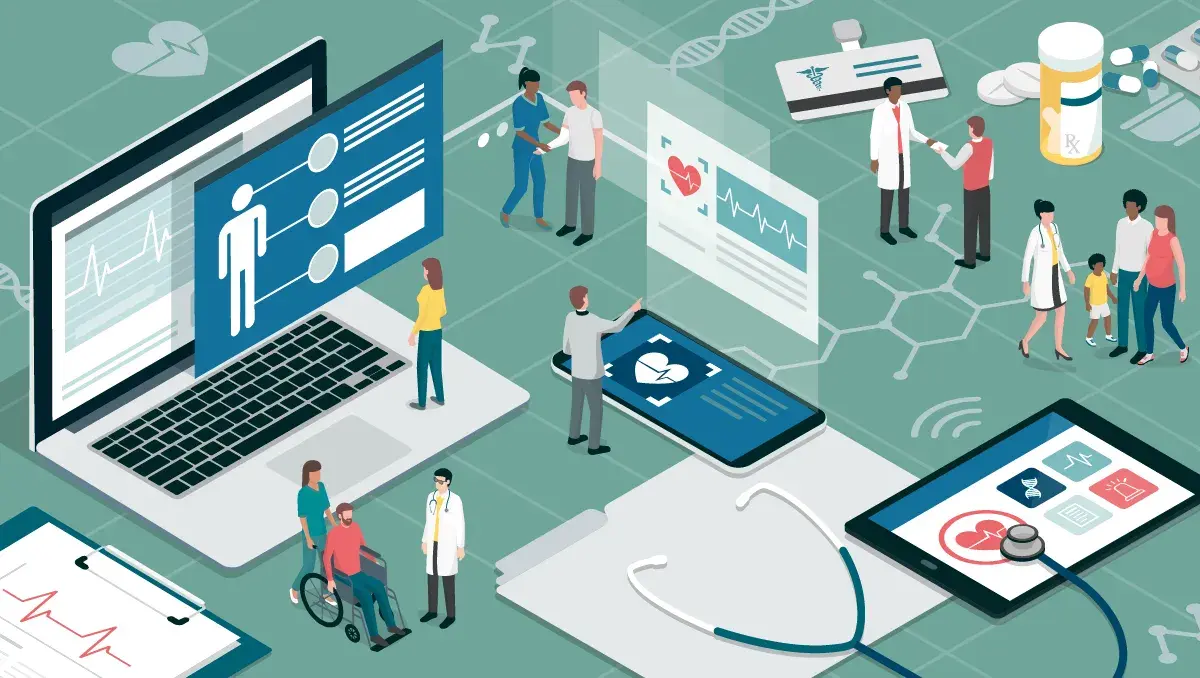
At 7:30 a.m., a physician reviews overnight lab results before morning rounds. Across the hall, a registration team is processing new patient intake forms. In another office, claims data is being sent to an insurer. Different workflows, different systems, and different teams, but they all depend on information moving quickly and accurately behind the scenes.
Yet behind every one of these interactions is a continuous stream of information moving between EHR systems, laboratories, insurers, specialists, cloud applications, and external partners. For many healthcare organizations, data movement is managed through a patchwork of tools that lack centralized governance, visibility, and control.
And that ability to move data is becoming increasingly difficult. Why? Patient information, like information in most any industry, now moves across more systems, business partners, and digital channels than at any point in healthcare’s history. This is forcing organizations to rethink how they balance security, availability, and operational efficiency.
Many healthcare IT leaders still treat security and operational speed as competing priorities, even though the underlying cause of delays often has little to do with security itself.
The problem is rarely security itself. The real challenge is the collection of fragmented tools, manual processes, and disconnected workflows that sit between critical systems. Those inefficiencies create bottlenecks that can slow care delivery while leaving organizations with limited visibility into how their sensitive data is moving throughout the enterprise.
The Myth That Security Slows Care
Healthcare organizations have spent years layering security controls onto aging file transfer processes.
Files may be encrypted before transmission. Additional authentication may be required. Approval workflows might be introduced. Audit records often need to be maintained. Each of these controls serves an important purpose, but when an organization wants to implement them across disconnected systems, they can create friction.
The result is a common misconception: that stronger security inevitably slows operations.
What actually slows operations are manual handoffs, custom scripts, legacy FTP environments, and the lack of a centralized framework for managing data exchange.
A referral that requires staff intervention, a failed transfer that goes unnoticed, a billing file that must be manually resent, and an imaging study that becomes trapped in a disconnected workflow are all process problems, not security issues.
“Healthcare organizations are often told they must choose between stronger security and faster operations. However, security isn’t what slows care; it’s the manual processes, disconnected systems, and fragmented workflows. When security is built directly into those workflows, however, organizations can protect sensitive patient information while still ensuring data reaches the people who need it without unnecessary delays,” said Heath Kath, Team Lead, Solutions Engineering, Fortra MFT.
Where Delays and Risk Often Originate
A single patient encounter can trigger dozens of data exchanges across clinical, financial, and administrative systems before a case is fully resolved. In many organizations, these vital exchanges between labs, imaging, insurance companies, and providers still rely on a combination of email attachments, shared drives, FTP servers, custom scripts, and standalone tools. What may have begun as temporary solutions often become permanent infrastructure.
As systems grow, as they tend to do, visibility into the data starts to decline. When a transfer fails, teams may not even realize it right away. And, when data is manually handled, errors tend to increase. In addition, proving HIPAA and HITECH compliance becomes much more difficult and inefficient when audit information is scattered across multiple platforms.
Establishing a secure connection is just one part of the challenge; organizations also need visibility into whether information arrives, who accessed it, and what happened if a transfer fails.
Why Security Failures Become Patient Care Problems
Cybersecurity incident discussions often center on compliance penalties, regulatory investigations, or financial impact. Those consequences are all too real and painful. Yet they only tell part of the story.
When healthcare data is exposed, delayed, or becomes unavailable, the effects can extend beyond IT operations. Clinical workflows may be disrupted; staff may need to shift to manual processes; care coordination can become more difficult; and patient trust can suffer, long after the breach or failure occurred.
Healthcare continues to rank among the most expensive industries for data breaches according to IBM's 2025 Cost of a Data Breach Report, highlighting the significant operational and financial consequences associated with compromised patient information. The report reveals the average healthcare breach costs $7.42 million per incident, and healthcare has held the top position for breach costs for 14 consecutive years, indicating this data is a prime target of cyberthieves.
For healthcare leaders, protecting data is not only a compliance objective; it also is an operational requirement. Therefore, prioritizing stronger governance around the movement of sensitive information is key. Secure data exchange supports both privacy obligations and the more visible day-to-day delivery of care.
How MFT Helps Remove Friction from Healthcare File Transfers
Healthcare organizations rarely exchange information with only internal systems. Patient data routinely moves among providers, laboratories, insurers, pharmacies, and third-party service providers. Centralized management of these partner exchanges helps ensure sensitive information remains protected while providing the visibility and auditability required to support compliance initiatives.
Managed File Transfer (MFT) was designed to address a problem familiar to many healthcare organizations: critical information needs to move securely, reliably, and without constant manual oversight. Centralizing file transfers, workflows, and governance into a single platform, GoAnywhere MFT helps healthcare organizations eliminate the tradeoff between security, compliance, and operational efficiency.
Instead of managing file transfers through a collection of scripts and point solutions, organizations can centralize data exchange within a single, governed platform. This focus shift is less now about securing individual transfers than managing entire workflows.
Files can be encrypted automatically, and transfers can be triggered based on schedules or business events. To ensure files are handled as organizational policies require, file transfer policies can be applied consistently regardless of where data originates or where it is being sent. And teams can gain visibility into file activity from a central location rather than piecing together information across multiple systems.
For healthcare organizations, these capabilities mean less time is spent troubleshooting routine transfers and more confidence that sensitive information is moving properly between systems and stakeholders.
Automation Isn't Just About Efficiency
When healthcare teams hear the word "automation," the discussion often focuses on reducing administrative effort. While that's certainly a benefit, automation can also reduce risk.
Every manual file upload, download, email attachment, or scripted process introduces opportunities for mistakes. Files can be sent to the wrong destination; transfers can be delayed, and critical information can be overlooked.
Automation helps eliminate many of those failure points. For example, organizations can automatically route laboratory files, process claims data, distribute referral documentation, trigger notifications, and monitor transfer completion without requiring staff intervention at every step.
The result is not simply faster processes. It is more consistent processes.
“Automation is often associated with speed, but in healthcare, its value goes much deeper. Every manual handoff, file upload, or workaround introduces opportunities for delays, errors, and compliance gaps,” said Kath. “By automating how sensitive information moves between systems, organizations can reduce risk while creating more reliable processes that support both operational performance and patient care.”
GoAnywhere's workflow automation capabilities, event-based triggers, centralized management, and monitoring capabilities support these efforts by allowing organizations to standardize how data moves across healthcare environments.
Compliance Becomes Easier When Security Is Built In
Healthcare organizations are no strangers to regulatory obligations, with HIPAA, HITECH, PCI DSS requirements on the upswing.
Protecting PHI, maintaining audit readiness, and demonstrating appropriate controls over sensitive information requires ongoing effort. Yet compliance becomes far more manageable when governance is embedded directly into data exchange processes.
GoAnywhere has built-in features such as:
- Encryption
- Role-based access control
- Detailed audit logging
- Centralized reporting
- Policy-driven workflows
Each of these features help organizations establish consistent controls over file movement. These capabilities support compliance initiatives while reducing the burden associated with manual documentation and investigations.
Modern MFT platforms also support capabilities such as multi-factor authentication (MFA), secure data intake through web forms, and controlled workflows that help reduce exposure to sensitive patient information while maintaining efficient operations.
Just as importantly, they provide organizations with the visibility necessary to answer a common question: What happened to this file? When that answer is readily available, both compliance and operations benefit.
The Real Goal Is Trust
Healthcare organizations invest in secure file transfer because they need both operational efficiency and strong protection for sensitive patient information. That objective sits at the intersection of security, compliance, operational performance, and patient trust.
As healthcare ecosystems become increasingly connected, the organizations that succeed will be those that can protect sensitive information without creating barriers for care teams, patients, or business partners.
Modern MFT helps achieve that balance by providing the control healthcare organizations need while supporting the speed that care delivery demands. Secure patient data and efficient operations should not be competing priorities. They should be part of the same strategy.
“At the end of the day, the objective isn’t simply file transfer; it’s making sure critical information gets to the right people at the right time. When healthcare data moves securely and reliably, clinicians can focus on care instead of chasing information,” added Kath. “Bringing in an MFT solution like GoAnywhere helps simplify administration, automation, data auditing, and management. It also helps solve unique challenges, like managing data across disparate infrastructure and onboarding new acquisitions in a more sufficient and secure manner.”
Frequently Asked Questions
Safeguard Patient Data Without Slowing Down Care
Learn how healthcare organizations can protect patient data, support HIPAA compliance, and remove workflow bottlenecks with secure, automated MFT solutions.