
If you’ve ever had to MacGyver a way to send out a too-large file or work with a group of people on a single document, EFSS is probably what you were looking for to make the process painless: it’s a solution that makes sharing files (of any size) and collaborating in one place easy – and secure.
What is EFSS?
EFSS stands for Enterprise File Syncing and Sharing, also commonly known as Enterprise File Sync and Share.
In simple terms, an EFSS solution is a secure enterprise file sharing and content collaboration platform. This platform is designed to combine file storage, file synchronization, secure sharing, and collaboration tools into one system. These EFSS systems are typically cloud-based or hybrid and are designed to work across devices, locations, and teams, supporting global enterprise file synchronization needs.
Companies rely on sharing information and collaborating with both internal and external stakeholders, and EFSS software gives businesses the ability to securely share files internally and with trading partners and customers, whether by moving data from point A to point B or as a way to work on a document together. EFSS software makes file sharing and collaboration efficient, flexible, and secure.
EFSS services address common challenges such as transferring large files, managing version control, and coordinating work across distributed teams. Instead of relying on consumer-grade tools, more organizations today have adopted enterprise file sync solutions that provide greater control, visibility, and security for their business data.
Know Your Terms: GoAnywhere Glossary
What Makes It Enterprise?
Enterprise File Sync and Share solutions aren’t only for large businesses – they can benefit companies of any size that are searching for a way to securely transfer files or need to collaborate often or across locations. Most of the tools people use in their everyday lives – email, Google Drive, Box, shared photo albums in Apple, to name a few – don’t hold up to the security standards or compliance regulations businesses adhere to, which is where EFSS comes in. EFSS software is built for business needs.
How is enterprise file sharing different from consumer tools? Consumer platforms are designed for convenience, while EFSS platforms are built with advanced security controls, access governance, audit logging, and compliance support in mind. For businesses handling sensitive data or operating under compliance frameworks, using consumer tools introduces risks such as unauthorized access, lack of audit visibility, and limited control over data movement.
EFSS systems provide enterprise-grade capabilities that support compliance requirements and secure collaboration across departments, partners, and customers, making them a preferred solution for large enterprises and regulated environments.
Case Study: Cancer Registry of Greater California
How Does EFSS Work Behind the Scenes?
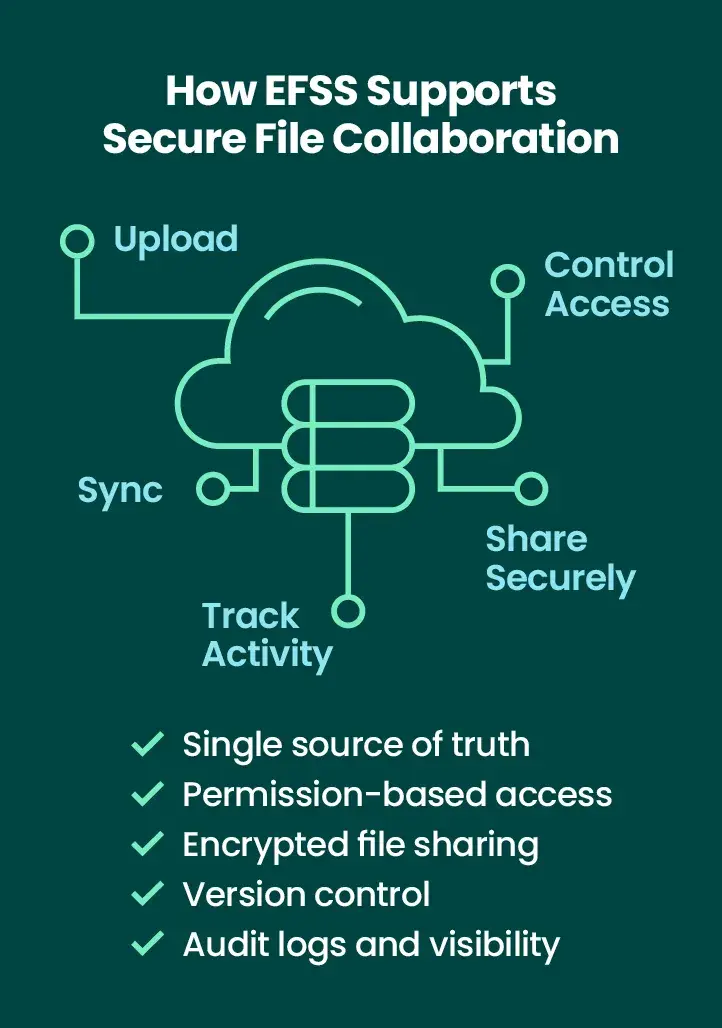
EFSS platforms operate through real-time updates and version control, allowing users to work from a single source of truth while maintaining full visibility into file activity. The process follows a structured flow:
- A file is uploaded or created within the EFSS platform
- The file is stored securely in the cloud or on-premises environment
- File synchronization updates authorized devices in real time
- Access is controlled through permissions and user roles
- Files can be securely shared with internal teams or external partners
How Do File Synchronization and Sharing Work?
The syncing power of EFSS means the master document stays the master document. No more searching through multiple versions in your downloads or waiting to get back on your office machine to make a quick edit. Users can work on the latest document version from any approved device with enterprise file synchronization.
This level of file sync capability supports a single source of truth, eliminating version confusion and improving collaboration across teams. Governance controls built into EFSS systems help maintain visibility and control over file access and activity.
Most EFSS solutions make accessing secure folders and files simple, as well as adding user permissions to those folders. This permission-based access allows organizations to control who can view, edit, or distribute files. Some EFSS solutions also include the ability to share files of any size by email. This approach supports both internal collaboration and external content collaboration with partners and customers.
Related Reading: 4 Benefits of On-premises Enterprise File Sync and Sharing
What Security Features Do EFSS Systems Provide?
EFSS systems are designed to protect data at every stage of file movement and storage. They anticipate the main downsides of file sharing: unsecure and unauthorized sharing. Whether by sending secure messages and files via HTTPS connection–or by giving you localized control–EFSS gives you the tools you need to keep sensitive data within your organization.
This includes multiple layers of security deigned to reduce the risk of data leaks and unauthorized access including:
- End-to-end encryption for data in transit and at rest
- Secure transfer protocols, such as HTTPS
- Granular access controls and user permissions
- Multi-factor authentication (MFA) for user verification
- Audit logs and activity tracking for visibility
- Data loss prevention capabilities to protect sensitive information
These features align with modern security frameworks and support a zero-trust approach, where access is continuously verified and monitored.
How Does EFSS Provide Secure Access from Anywhere?
By including security capabilities like end-to-end encryption, tracking features, and audit logs, EFSS solutions provide control that is leaps and bounds ahead of other file sharing and storage tools. With EFSS you can access, edit, and share files from any approved device, and across popular web apps with total security.
This flexibility supports the needs of a remote workforce, allowing users to securely access files from desktops, mobile devices, and different locations while maintaining full control over authentication and permissions. Integration with enterprise systems further extends access while preserving security and compliance.
Why Do Enterprises Combine EFSS with MFT?
EFSS platforms provide a collaboration layer for file sharing and access, while Managed File Transfer adds automation, compliance, and visibility for large-scale data movement.
When combined, organizations benefit from:
- Secure file sharing across teams and partners
- Automated file transfers and workflows
- Full visibility into data movement and access
For example, a team may use EFSS for collaboration on a document while MFT handles automated delivery of finalized files to external systems, creating a complete and controlled file management process.
Why Use an EFSS Solution?
Organizations adopt EFSS platforms to achieve measurable outcomes across security, collaboration, and efficiency. Key benefits include:
- Improved collaboration across teams and departments
- Enhanced security for sensitive data
- Better file organization and visibility
- Reduced reliance on email attachments
- Increased productivity through streamlined workflows
- Scalable enterprise file sharing capabilities
With flexible deployment options – including cloud, on-premises, and hybrid environments – EFSS platforms provide the adaptability needed to support modern business operations while maintaining control over data.
Solutions like GoAnywhere extend these capabilities by combining enterprise file sharing with secure transfer, automation, and centralized control, allowing organizations to manage both collaboration and data movement within a single platform
Make sharing sensitive files and collaborating with colleagues, customers, and trading simple with an EFSS tool. Control your sensitive data – whether on-premises or in the cloud – with GoAnywhere MFT. It’s enterprise-grade file sharing, without the enterprise-grade cost.
Learn More: Watch our on-demand Content Collaboration Webinar